CommunityScale completed a city-wide housing plan for Greenfield, MA. The project was led by Jeff Sauser, a Greenfield resident and CommunityScale’s co-founding Principal, ensuring the project benefits from local insights and direct community involvement. Levine Planning Strategies, renowned for their work in affordable housing policy, joined the project, bringing a wealth of experience from across New England to tailor solutions that meet Greenfield’s unique challenges.
View full study results on the project dashboard and within the final report.
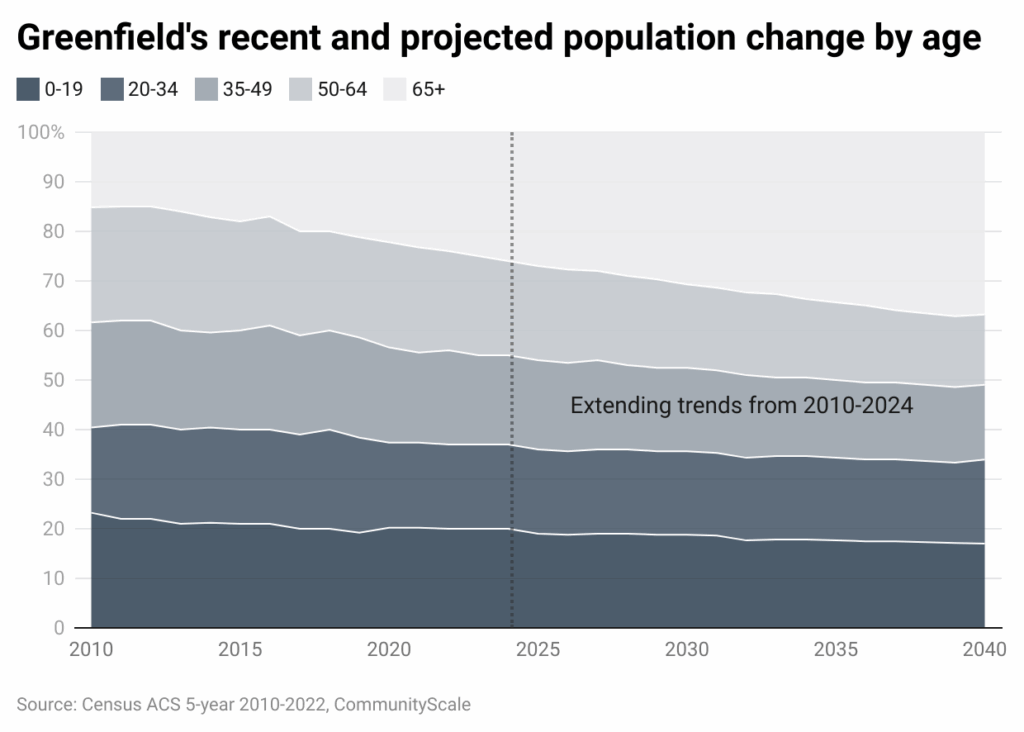
Key components of the project included a comprehensive Housing Needs Assessment to determine current and future demands, interactive community engagement through a dynamic website, and a focus on actionable insights to inform policy and development. The plan outlines strategies to improve housing affordability and meet the diverse needs of the community through targeted policy recommendations and a detailed housing production strategy.
The plan recommended the City build 675-1,100 new units over the next decade (including existing pipeline development), covering a mix of affordability levels from low and moderate-income to market rate.
The following recommendations were elevated as near-term strategies to catalyze housing production:
| Strategy | Action |
|---|---|
| Revise zoning to promote more housing production | Update the zoning ordinance to enable more housing throughout the city, addressing dimensional requirements, allowable uses, parking provisions, and other regulating factors. |
| Update ADU ordinance | Remove provisions that limit or slow ADU production and comply with new state legislation as applicable. |
| Introduce inclusionary zoning and density bonuses to zoning code | Add an inclusionary zoning provision that provides incentives for developers to include affordable units in market-rate projects. Consider density bonuses that are significant to truly unlock development opportunities in suitable locations such as in and around downtown. |
| Position the Hope Street lot for housing development | Perform or commission a feasibility study to inform next steps including readying the site, preparing development scenario, crafting incentives as needed, and seeking a development partner. |
| Establish a housing trust fund | Create a housing trust fund and capitalize it with CPA funds. |
| Explore UCH-TIF to support downtown development | Study the potential use of Urban Center Housing Tax Increment Financing (UCH-TIF) as an incentive to improve the development feasibility of housing projects downtown, such as a market- or mostly market-rate development on the Hope Street lot. |
| Market Greenfield to the regional and national development community | Begin outreach to regional and national developers, promoting Greenfield as a promising place to invest and discussing incentives and partnerships that might catalyze new development in line with City goals. |
To help the City navigate ongoing policy changes at the state level, CommunityScale also provided a supplementary study focused on ADU policy and implementation guidance.